
A lottery digit missing for 20 draws: history is not the next-draw probability
Published — UTC
A digit absent from a history window is not automatically excluded from the next result. In an independent model, the next probability comes from the model’s rule, not from how long the digit has been missing.
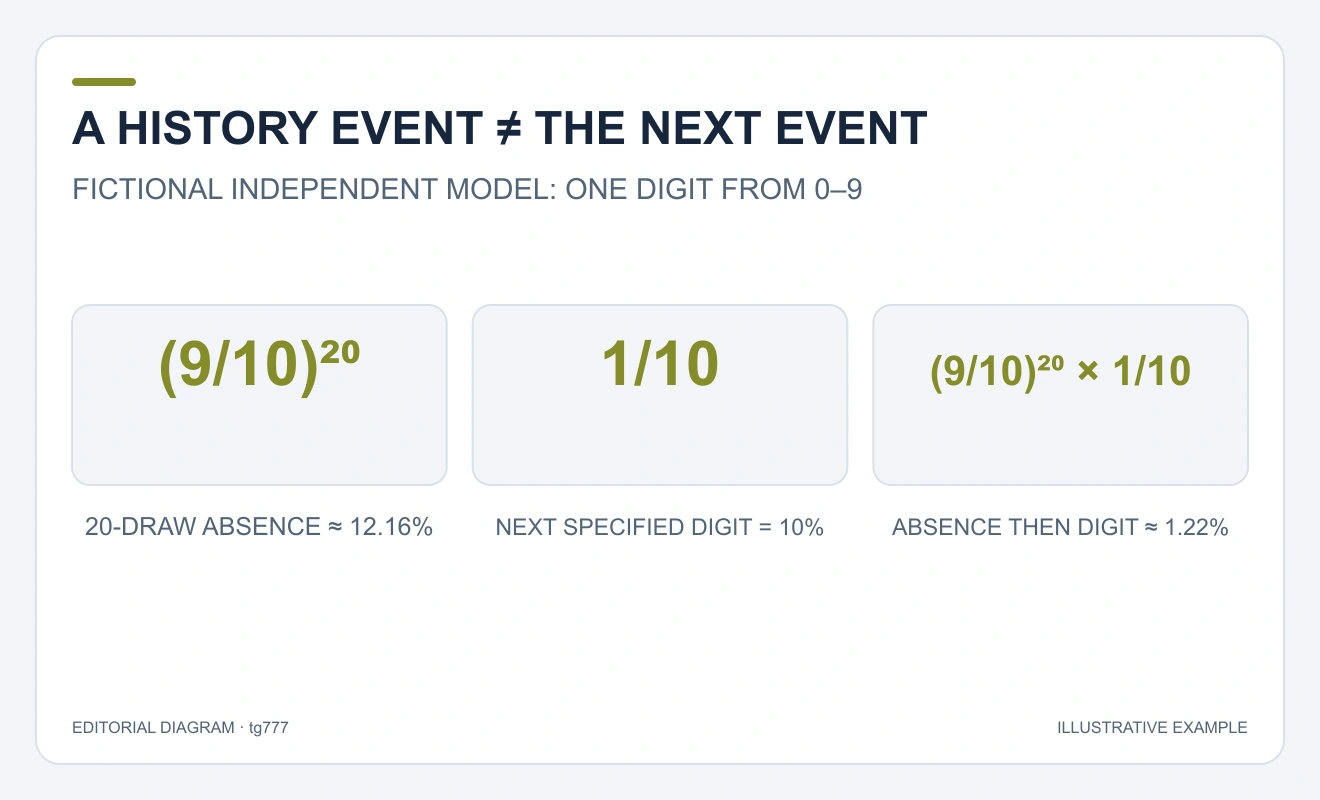
State independence rather than assuming it
Take a fictional draw that selects one digit from 0–9 with equal probability, resets completely and repeats independently. For one specified digit, the chance of absence in one draw is 9/10. Its absence in twenty draws is (9/10)20, approximately 12.16%.
That is a probability of a twenty-draw history event. The next draw still assigns the specified digit 1/10 under the stated assumptions. Neither “absent, therefore impossible” nor “overdue, therefore certain” follows.
History and the next event have different boundaries
A table counting the last twenty results describes those twenty observations. Adding the next result changes the window. Keep observed frequency separate from a probability calculated using a stated mechanism.
What would invalidate this calculation?
A draw without replacement from a finite pool, unequal digit probabilities or a changing selection mechanism needs another model. A screenshot of past results alone cannot prove the reset or independence assumptions.
OpenStax explains independence through whether one event changes another event’s probability. That definition supports the distinction here; it does not verify the mechanism of any lottery on this website.
Three calculations that answer three questions
Specify digit 7 before observing the model. The probability that it is absent from twenty draws is about 12.16%. Before those draws occur, the probability of that absence followed immediately by a 7 is (0.9²⁰) × 0.1, about 1.22%. Once the twenty-draw absence is already known, however, the next-draw probability is still 10% in this independent model. The 1.22% joint probability is not the answer to that conditional question.
Contrast a pool that does not reset
Imagine a different experiment: ten distinct balls labelled 0–9 are mixed, one is removed and it is not replaced. If the removed ball is 0, nine remain and the chance of drawing 7 next is 1/9 under uniform mixing. If the removed ball is 7, drawing another 7 from that single-copy pool is impossible. These are consequences of a changed pool, not of a number becoming “due”.
That experiment is not the model used in the twenty-draw calculation. The example shows why “the last result is different” does not settle the question; the replacement and reset rule matters.
Was the digit chosen before or after inspecting history?
“Digit 7 was specified, then absent for twenty draws” differs from “I looked across all ten digits and found one that was absent.” The latter search can identify several possible digits and needs its own event definition. Do not quote the single-digit 12.16% calculation as the probability of that broader search.
Keep the observation reproducible
Record the first and last draw IDs, the count of completed draws, missing records and the digit being counted. A gap in the downloaded history is not an observed absence. Preserve corrected results as revisions of their draw IDs rather than additional draws. A complete history can establish a frequency in that window; without evidence about the mechanism it cannot establish independence or a future guarantee.