
Consecutive lottery numbers: one chosen run is different from any run
Under a uniform six-from-42 draw model, the specific set {1, 2, 3, 4, 5, 6} has the same chance as any other specific six-number set. But “any six consecutive numbers” is a larger event because it includes many different sets.
The common mistake is to compare one named combination with an entire category of combinations as if they were the same question.
State the model before discussing probability
Assume six distinct numbers are drawn from 1–42 without replacement, order does not matter, and every six-number set is equally likely. These assumptions define our mathematical example; they are not measurements of a draw machine.
Using the combination method described by OpenStax, the number of sets is C(42,6) = 5,245,786. Every fixed six-number selection occupies one place in that space.
Count all the consecutive runs
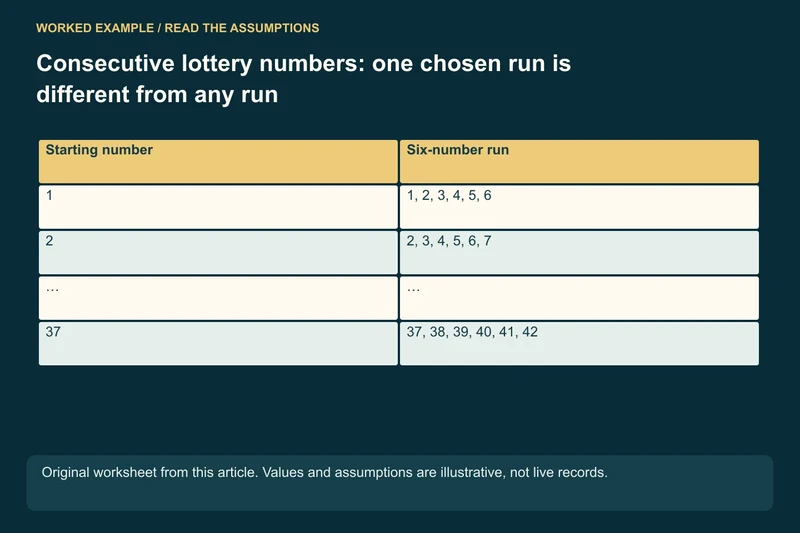
| Starting number | Six-number run |
|---|---|
| 1 | 1, 2, 3, 4, 5, 6 |
| 2 | 2, 3, 4, 5, 6, 7 |
| … | … |
| 37 | 37, 38, 39, 40, 41, 42 |
The first number can be 1 through 37. Starting at 38 would require 43, outside the defined range. There are therefore 42 − 6 + 1 = 37 different consecutive sets. Each six-number result can equal only one complete set, so these 37 outcomes are distinct.
Compare like with like
The chance of the specific run 1–6 is 1/5,245,786. The chance that the result belongs to any of the 37 complete consecutive runs is 37/5,245,786. The second event is larger because it contains 37 sets, not because the particular run 1–6 has become more likely.
A nonconsecutive set such as {2, 9, 17, 25, 33, 41} is also one specific set. Under the assumptions, its chance is the same as 1–6. Calling one pattern unusual does not change that one-set count.
Do not turn a category calculation into a number tip
The example says nothing about how other people choose numbers, prize sharing, current ticket costs or a future result. Those require different evidence. It also does not say that every category someone invents contains the same number of sets.
When reading an odds claim, write the event precisely: this exact six-number set, any six consecutive numbers, or merely at least one adjacent pair. Those are three different events. The denominator may stay the same while the favorable-outcome count changes.
The tg777 homepage brings together the site’s other reading topics.
Source-based editorial research and original examples. Sources checked 9 October 2026. No real-money play or account transaction was performed for this article.