
GUIDE · tg777
Does the ball go back? The rule that changes a lottery count
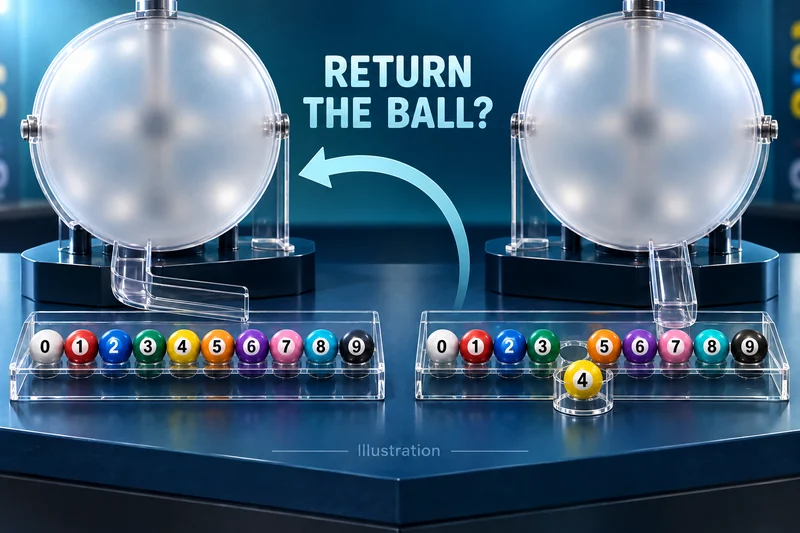
“Choose three numbers from ten” is not a complete rule. Can the same number appear twice? Does the order matter? Those two details change the count, even though the visible number range stays the same.
We can isolate the difference with ten distinct balls labelled 0 through 9. Three draws are made. This is an invented classroom model, not a claim about how a named lottery runs its equipment or pays prizes.
Model A: return the ball after each draw
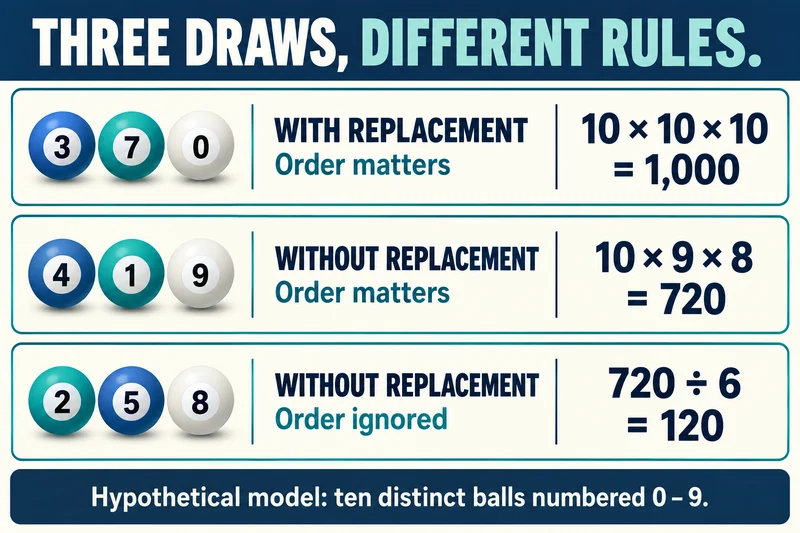
Put each drawn ball back before the next selection, and mix again. There are ten possibilities for the first position, ten for the second and ten for the third. The count is 10 × 10 × 10 = 1,000 ordered sequences.
A sequence such as 4-4-7 is possible because the 4 is available again. The repeated label is permitted by the model. We have not counted it twice by mistake.
Model B: keep each drawn ball outside
Without replacement, the first position has ten possibilities, the second nine and the third eight. The count becomes 10 × 9 × 8 = 720 ordered sequences. Now 4-4-7 is impossible: there is only one ball labelled 4, and it has already been removed.
In this model, 2-5-8 and 8-5-2 are different ordered records. They contain the same labels, but the first and last positions differ.
Model C: remove the balls, then ignore their order
Start with the same no-replacement draws as Model B, but group together sequences containing the same three labels. The set {2,5,8} can be drawn as 2-5-8, 2-8-5, 5-2-8, 5-8-2, 8-2-5 or 8-5-2. Six ordered records describe that one unordered set.
Because every no-replacement result has three different labels, every set has the same six arrangements. Dividing 720 by 6 gives 120 unordered sets. This division would need reconsideration if repeated labels were allowed; swapping two identical labels would not create a new sequence.
Counts become probabilities only under stated assumptions
If each available ball is equally likely at every draw, a specified ordered sequence has probability 1/1,000 in Model A or 1/720 in Model B. A specified unordered set has probability 1/120 in Model C. These are conditional properties of our toy models, not odds quoted for a real product.
OpenStax’s probability terminology defines outcomes and sample spaces and explains the equal-likelihood condition behind simple outcome counting. That condition is why the model states how each draw is made rather than using the number of pictures on a screen.
Three fields to keep in an existing lottery record
Write down the allowed labels, whether a label may repeat and whether position matters. Keep any special-number field separate. Those details determine which model, if any, resembles the product’s documented matching rule.
The six-number range comparison studies a different question: changing the size of a range while keeping six distinct selections. The tg777 number-games page helps identify the product before comparing records. Both are available from tg777.
AI-assisted source research and original explanation. No gameplay, payments or operator-availability testing was performed. Sources checked 2026-10-08.